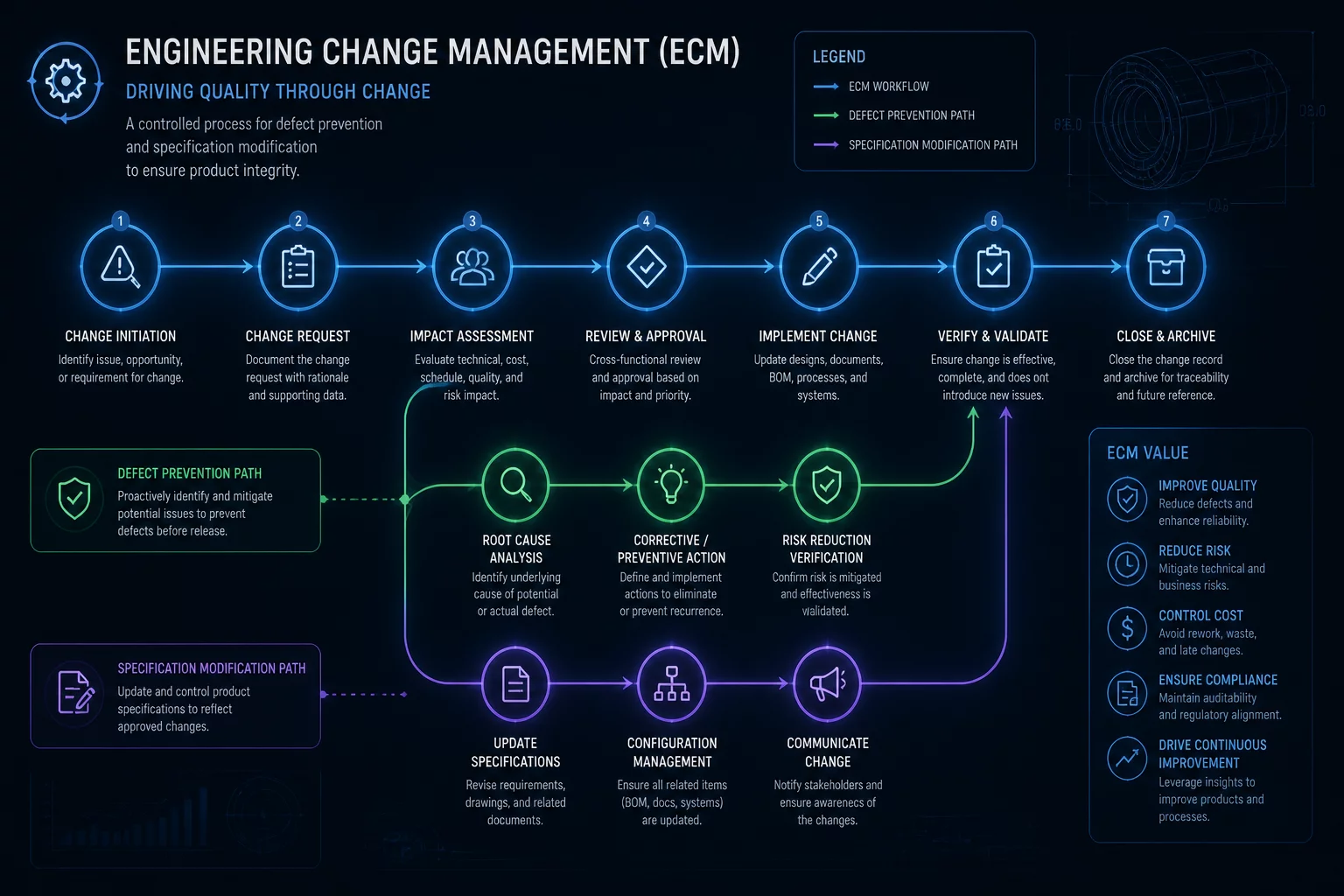
Overview of Topics
01 Configuration Fragility and Revision Drift
In high-mix, engineer-to-order (ETO) and configure-to-order (CTO) production environments, geometric adjustments frequently occur in isolation from enterprise resource planning systems. When a design engineer modifies a hole pitch, wall thickness, or fastener selection inside a 3D CAD environment, the revision status of the model can easily become decoupled from the active bill of materials (BOM) on the production floor.
The Friedman Corporation framework emphasizes that change management must never treat CAD models as detached files. Instead, every dimensional revision initiates a ripple effect across procurement schedules, custom tooling fixtures, and assembly instructions. Uncontrolled revisions lead directly to assembly line standstills, obsolete inventory buildup, and severe warranty liabilities.
Critical Principle
An engineering change order is only complete when physical tooling calibrations, supplier purchase orders, and shop-floor digital twins reflect identical revision numbers simultaneously.
02 The 5-Stage Change Governance Pipeline
To eliminate human error during drawing handoffs, the guide formalizes a multi-step verification protocol. Each stage isolates potential downstream disruptions before raw materials are cut or stamped:
- Engineering Change Request (ECR) Generation: Field engineers and plant technicians submit formal defect or enhancement tickets detailing observable failure modes.
- Cross-Disciplinary Impact Simulation: Automated checkers evaluate how geometry changes alter mating parts, structural stiffness, and routing clearances across the complete assembly hierarchy.
- Cost and Inventory Scrap Assessment: ERP connectors calculate the financial write-off value of parts already stocked in warehouse bays against the cost of the proposed revision.
Once all stakeholders approve the preliminary assessment, the protocol issues an automated Engineering Change Order (ECO), locking previous revision files into read-only archives while provisioning newly versioned components directly into the active production sequence.
03 ERP and CAD Synchronization Best Practices
The core differentiator in the Friedman Corporation methodology lies in deep data synchronization between the CAD product data manager and the ERP inventory module. Rather than relying on manual CSV exports or duplicate data entry, parametric changes in the CAD tree automatically prompt updates in item master tables, vendor RFQs, and computer-numerical-control (CNC) post-processors.
By strictly adhering to centralized revision flags, manufacturers maintain complete audit readiness and eliminate discrepancies between theoretical CAD geometry and the physically fabricated unit. This methodology ensures predictable lead times, protects margin thresholds, and builds high resilience across custom assembly operations.
Gordon Hayes
Operations DirectorThe emphasis on automating scrap cost calculation during the ECR stage directly addresses our plant's biggest bottleneck. Tying CAD revision states to the active ERP inventory ledger eliminates unauthorized shop-floor rework entirely.