Table of Contents
01 Core Revisions in the 2026 Standard Framework
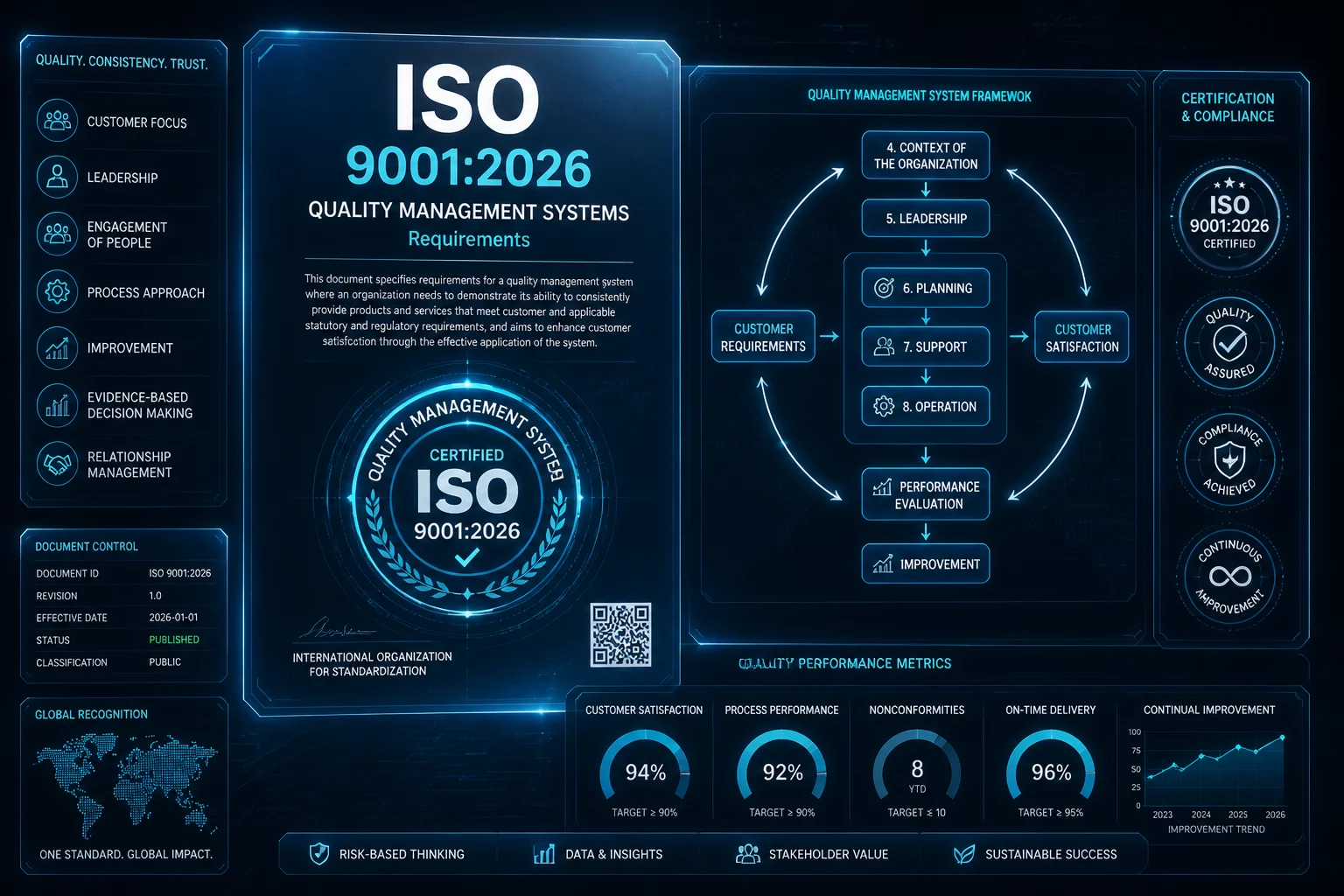
The International Organization for Standardization has formally published the ISO 9001:2026 standard, marking the first major overhaul of the foundational quality management framework in over a decade. While the familiar Annex SL high-level structure remains intact to preserve cross-standard harmonization, the 2026 text introduces critical mandates addressing automated data processing, algorithmic risk mitigation, and climate change risk governance across all organizational operations.
Quality managers must now prove that digital transformation initiatives do not compromise product traceability or verification rigor. The updated standard explicitly categorizes automated software scripts, automated drawing generation pipelines, and cloud-hosted product data repositories as critical quality infrastructure requiring rigorous change management controls.
Mandatory Traceability Protocol
Under ISO 9001:2026 Clause 7.5.3, organizations must demonstrate unbroken electronic revision history for all engineering documents and associative 3D CAD assets from initial concept through shop-floor inspection.
02 Practical Impacts on CAD and Engineering Documentation
For engineering and drafting teams, ISO 9001:2026 eliminates ambiguity surrounding algorithmic modifications and automated drafting outputs. Design departments are required to establish systematic verification checkpoints prior to releasing production drawings into manufacturing channels:
- Automated Derivative Verification: Every STEP, DXF, or PDF generated automatically by cloud-native CAD systems must undergo programmatic or certified human inspection to prevent silent translation anomalies.
- Dynamic Bill of Materials (BOM) Auditing: Clause 8.1 requires explicit synchronization logs between parametric CAD assembly configurations and enterprise resource planning item masters.
- Digital Supplier Exchange Standards: Subcontractor drawing packages require timestamped cryptographic hashing or tamper-evident version manifests to eliminate out-of-date sheet fabrication errors.
These practical criteria mean quality teams cannot rely on manual paper sign-offs when downstream manufacturing systems consume direct digital geometry. CAD administrators must actively configure automated change tracking and clear role-based approvals.
03 Auditing Workflows and Step-by-Step Transition Strategy
Accreditation bodies have established a standard three-year migration window, giving certified enterprises until late 2029 to align internal procedures with ISO 9001:2026. Internal audit protocols must transition from periodic sampling toward real-time telemetry verification across digital release workflows.
Organizations should begin by conducting a comprehensive gap analysis across engineering document control procedures. Upgrading drawing templates to display machine-readable metadata, configuring webhook triggers for revision changes, and training design personnel on digital risk assessment will ensure a smooth certification audit.
Elena Marchetti
Lead ArchitectThe clarification on automated derivative validation under Clause 7.5.3 directly resolves our internal debate regarding cloud-based STEP exports. Establishing mandatory digital hash manifests will significantly reduce our supplier dispute rates.