Table of Technical Contents
01 Core Architecture & Modernized Runtime Engine
The official debut of AutoCAD 2027 marks a decisive architectural evolution in Autodesk's primary drafting environment. Rather than focusing merely on surface-level visual tweaks, the software transitions core graphics pipelining and data handling onto the unified .NET 10 infrastructure. This foundation unlocks multithreaded processing across multi-core processors, resulting in fluid pan-and-zoom performance across complex industrial plant layouts and heavy civil drawings.
Engineering teams working with dense external reference (Xref) trees benefit from asynchronous background caching. Instead of locking the main user interface during reference reloads, AutoCAD 2027 delegates geometric computation to background threads, permitting uninterrupted drafting operations while nested annotations and boundary definitions sync in parallel.
Runtime Compatibility Notice
Legacy C++ and ObjectARX plugins compiled under prior .NET runtimes require re-targeting for .NET 10. The underlying DWG database schema maintains complete binary interchangeability with recent releases, preventing cross-version data loss.
02 Neural Pattern Recognition & Procedural CAD Cleanup
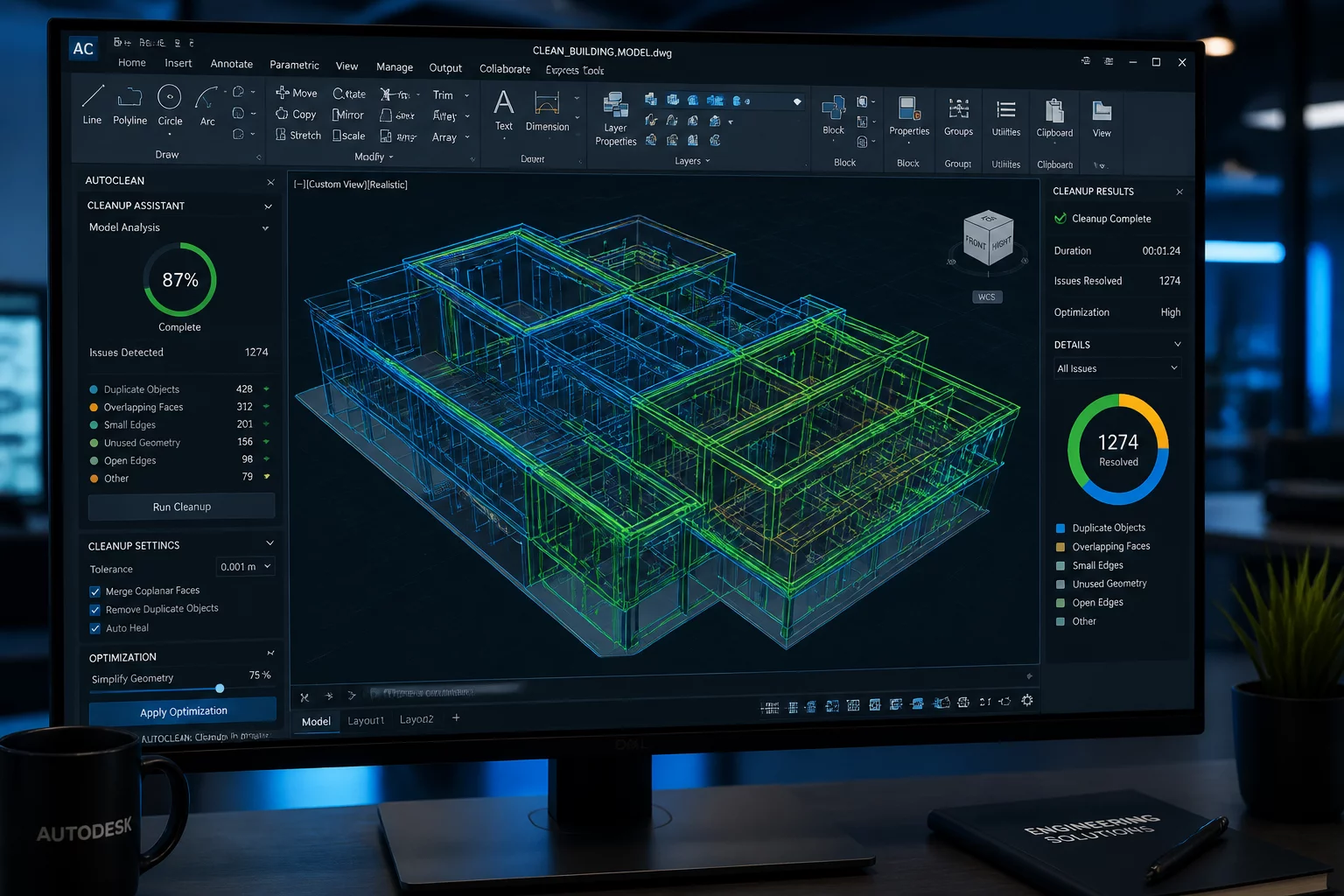
The core differentiator in AutoCAD 2027 is its integrated machine learning engine, engineered specifically for vector geometry audit and clustering. Operating locally on the workstation rather than through remote generative approximations, the system processes raw line and arc entities to eliminate redundant drafting overhead:
- Smart Block Clustering: Identifies repetitive unassociated geometric primitives across large schematic layouts, clustering them into unified dynamic blocks with standardized attribute tags.
- Automated Topological Error Scrubbing: Discovers micro-gaps, overlapping collinear segments, and non-coplanar vertex deviations, applying user-calibrated tolerance rules before publishing.
- Contextual Command Anticipation: Evaluates ongoing user operations to present appropriate annotation tools, layer assignments, and precision snaps at the cursor locus.
These procedural tools condense hours of manual drawing normalization into single-click validation passes, enforcing strict organizational CAD standards without disrupting existing layer filters or custom dimensioning templates.
03 Downstream Impact on Parametric Tables & External References
Revisions in AutoCAD 2027 propagate directly to connected schedules, data extraction tables, and external documentation sets. When geometric properties or block quantities change, associative table links immediately flag corresponding adjustments across multidisciplinary drawing sets.
This tight parametric coupling reduces documentation drift between layout sheets and production BOMs. By establishing transparent tracking between line work and tabulated values, engineering teams mitigate downstream manufacturing discrepancies and expensive job-site rework.
Elena Marchetti
Lead ArchitectThe precision engineering workflows and procedural parametric layouts exceeded all preliminary metrics. We integrated the structural model directly into our analysis pipeline with zero geometric conversion losses.